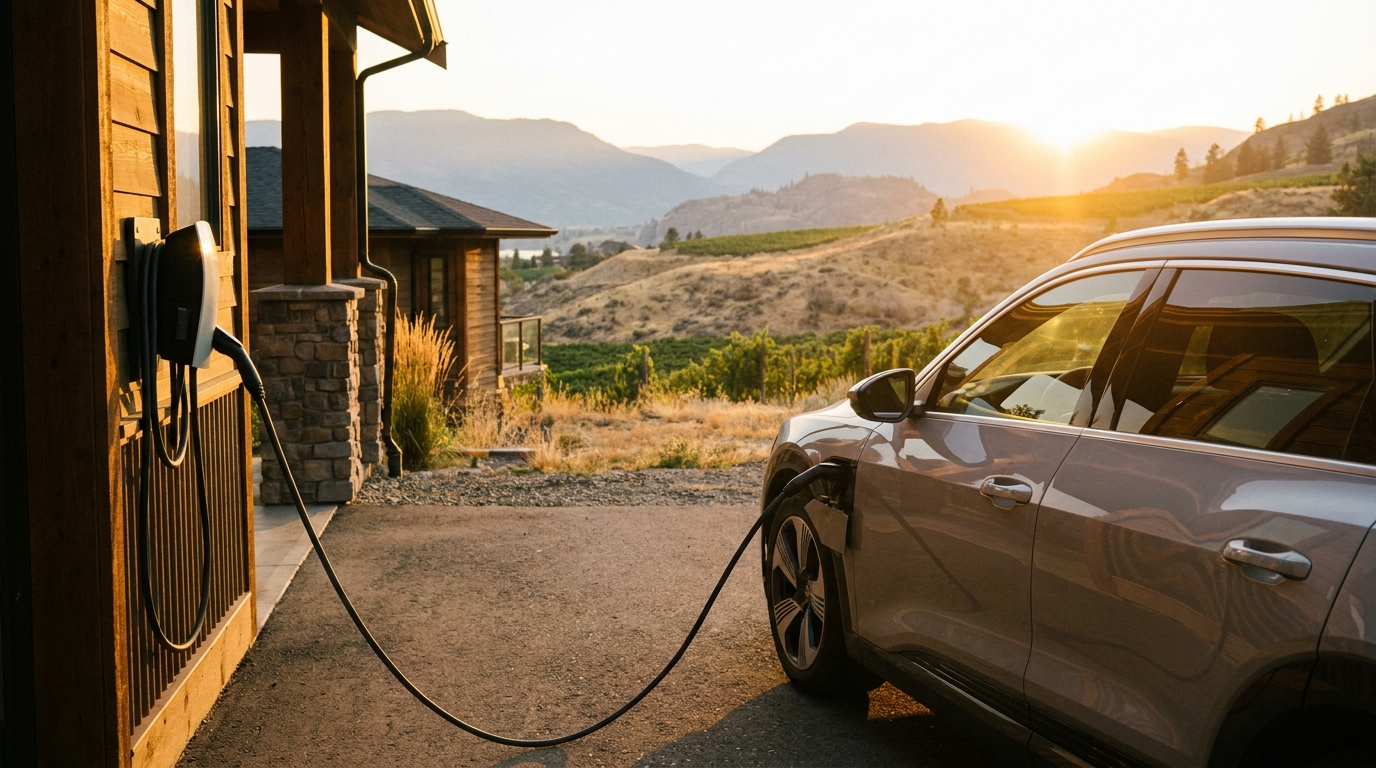
More Kelowna driveways have an EV in them every year, and sooner or later most owners hit the same wall: charging off a regular wall outlet is just too slow. A proper home charger fixes that, but installing one is an electrical project with a few decisions that are easy to get wrong. Here's what actually matters before you buy a charger and book an electrician.
Level 1 vs. Level 2 — why the outlet you have isn't enough
Home charging comes in two speeds. Level 1 is the cord that ships with the car, plugged into an ordinary 120-volt household outlet. It works, but it's slow — often only adding a handful of kilometres of range per hour. If you drive a little and can leave the car plugged in overnight for many hours, it can be enough for a plug-in hybrid or a light-use commuter.
Level 2 runs on a 240-volt circuit, the same class of supply as an electric range or dryer, and charges several times faster — typically enough to refill a daily commute in a couple of hours and a nearly empty battery overnight. For most Okanagan households with a full EV, Level 2 is the setup that makes ownership effortless. That speed is exactly why it needs a dedicated circuit rather than the outlet already in your garage.
The part people underestimate: your electrical panel
Here's where a home charger becomes more than "mount a box and plug it in." A Level 2 charger draws a lot of current continuously, so it needs its own dedicated 240-volt circuit run from your electrical panel. The real question is whether your panel has the room and capacity to add that load.
Many Okanagan homes — especially older ones, or newer homes that already run central air conditioning, an electric range, a hot tub, and maybe electric heat — are closer to their panel's capacity than owners realize. A qualified electrician does a load calculation to confirm your service can carry a charger safely. Sometimes it can as-is; sometimes you need a panel upgrade, or a smart charger that automatically dials its draw down when the rest of the house is using power (load management), which can avoid a costly service upgrade. This is exactly the kind of thing you want assessed before you commit to a specific charger.
Hardwired vs. plug-in, and where to put it
Level 2 chargers install two ways: hardwired directly into the circuit, or plugged into a dedicated 240-volt outlet (commonly a NEMA 14-50). Both are legitimate. Plug-in units are easier to swap or take with you; hardwired units are tidy and are sometimes required for higher-power chargers or outdoor installs. An installer will recommend based on your charger, your location, and the local electrical code.
Placement matters too. Think about where the car's charge port sits when parked, cord length and reach, and — because this is the Okanagan — weather exposure if the unit is outside or on an exterior wall. A charger rated for outdoor use, mounted where the cord reaches without stretching across a walkway, saves daily annoyance for years.
Permits and doing it to code
A dedicated 240-volt circuit is permitted electrical work. Using a licensed electrician who pulls the required permit protects your home insurance and your resale, and makes sure the circuit, breaker, and wiring are sized correctly for a load that runs for hours at a time. It's not the corner to cut — an undersized or improperly protected charging circuit is a genuine fire risk, and a permitted install is your paper trail that it was done right.
The Okanagan bonus: pairing a charger with solar
This is where charging gets genuinely satisfying in a sunny valley. If you have — or are planning — rooftop solar, you can time your charging to run during the day when your panels are producing, effectively fuelling the car on your own sunshine instead of grid power. Some chargers and home energy systems can even prioritize solar surplus, ramping charging up when the sun is strong.
Because a Level 2 charger and a solar array both tie into your home's electrical service, there's real value in having the same team look at them together — sizing the panel, the array, and the charger as one system rather than three separate afterthoughts. It's often cheaper and cleaner to plan for both at once, even if you install them in stages.
A quick checklist before you book
- Confirm your panel capacity first. A load calculation tells you whether you need a panel upgrade or a load-managing charger.
- Match the charger to your car and your driving. More amps isn't always better if your panel can't feed it — the electrician can advise the sweet spot.
- Decide hardwired vs. plug-in based on your charger and location, not guesswork.
- Insist on a permit and a licensed electrician. It protects insurance, resale, and safety.
- Think about solar now, even if later. Planning the charger and array together avoids paying twice.
Who to call in the Okanagan
Because a home charger is really an electrical project, hire accordingly. Okanagan Solar Ltd has been designing and installing electrical and solar systems across the valley since 2009, and installs EV charging stations alongside residential and commercial solar and battery storage — so they can assess your panel, recommend the right charger, and plan for solar in the same visit. You can see their services and reach out through their Okanagan Trade Directory profile.
Get the panel question answered first, install it to code, and — if the sun's already on your roof or headed there — set the charger up to sip from it. Do that, and home charging quietly becomes the best part of driving electric in the Okanagan.