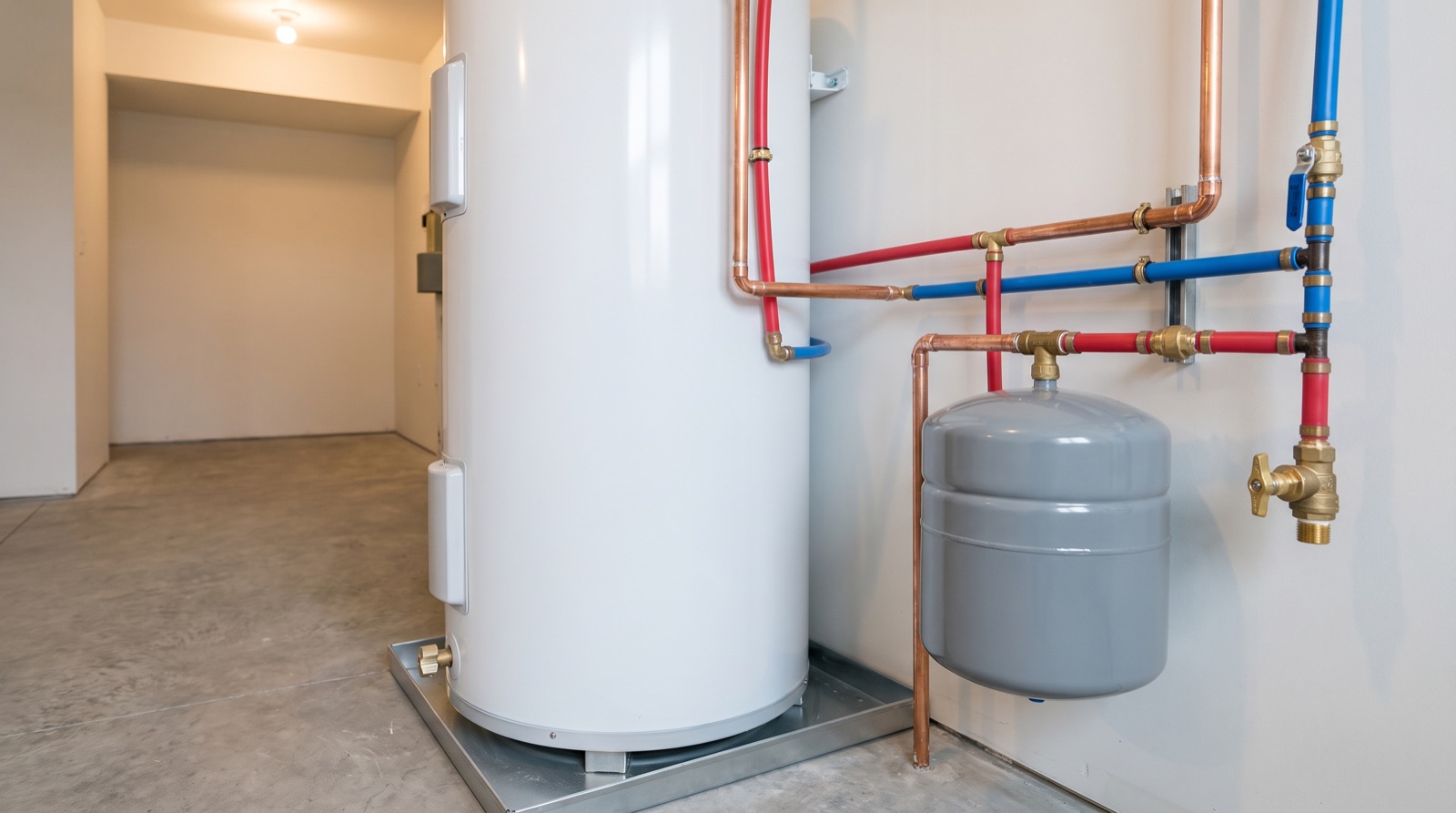
Hot Water Tank Replacement in Lake Country: Costs, Sizing and Timing
A hot water tank is the appliance people think about exactly twice. Once when it stops making hot water, and once when it empties itself onto the floor. Neither is a good moment to be making decisions or comparing quotes.
Here is what a replacement costs in Lake Country in 2026, how to size one so you are not paying for capacity you do not use, and the signs that yours is closer to the end than you think.
What it costs in 2026
Supplied and installed, including removal and disposal of the old tank, in the Central Okanagan:
| Type | Typical installed cost |
| --- | --- |
| 40 to 50 gallon electric tank | $1,800 to $2,900 |
| 40 to 50 gallon natural gas tank, atmospheric vent | $2,300 to $3,600 |
| 50 to 75 gallon gas power vent | $3,200 to $5,200 |
| Heat pump hybrid electric tank | $4,000 to $6,500 |
| Gas tankless, straight swap from a tank | $5,000 to $8,500 |
The spread inside each row is mostly about what has to change around the tank rather than the tank itself.
Things that push a straight swap up in price:
- The old unit is a different size or type and the venting has to change.
- There is no expansion tank and current code requires one on a closed system.
- The existing shut off valve or connections are seized and need replacing.
- There is no drain pan or no drain nearby, and one should be added.
- The tank lives in a tight utility closet, a crawlspace, or up a flight of stairs. Getting a full sized tank in and out is real labour.
- Seismic strapping, a new drip leg on the gas line, or an electrical circuit that no longer meets requirement.
- Going from atmospheric vent to power vent, which needs both a vent route through a wall and an electrical outlet.
Get a quote that names the model and states what is included. Tank, permit if required, removal and disposal of the old unit, new flex connections, new shut off, expansion tank, drain pan, and the warranty terms. A quote that is just a number and a brand is not comparable to anything.
Sizing it, without overbuying
The default reflex is to replace like with like, which is fine if the old one was right. Often it was sized by a builder for a different household.
Rough guidance for a standard tank:
- 1 to 2 people, 1 bathroom: 40 gallon electric or 30 to 40 gallon gas
- 3 to 4 people, 2 bathrooms: 50 gallon electric or 40 to 50 gallon gas
- 5 plus people, or 3 plus bathrooms, or a large soaker tub: 60 to 75 gallon, or a power vent gas unit with a higher recovery rate
Recovery rate matters more than volume for gas. Gas units reheat much faster than electric, so a 40 gallon gas tank often outperforms a 50 gallon electric one in real household use. If your complaint is that the last person in the shower gets a cold one, recovery is usually the fix, not raw capacity.
A big soaker tub changes the maths. A large tub can take most of a 50 gallon tank in one fill. If someone in the house actually uses it, size for that.
Tankless in Lake Country: worth it or not
Tankless makes sense for some households here and is oversold to others.
It works well when: you have natural gas, you have a household that uses hot water in long or overlapping draws, you value the endless supply, and you are staying in the home long enough for the efficiency to matter. Wall mounting also frees up real floor space in a tight utility room, which matters in a lot of Lake Country homes.
It works less well when: the gas line has to be upsized and the venting rerouted, which is common on a straight swap and is where the cost jumps. It also needs annual descaling maintenance, and Okanagan water hardness is not gentle on it. Skipping that maintenance is the most common way people end up disappointed with a tankless unit.
A reasonable rule: if you are already opening up the mechanical room, or building or renovating, tankless is worth pricing properly. If your tank died on a Tuesday and you need hot water by Thursday, a good tank is not a compromise.
The signs yours is near the end
A tank in the Okanagan typically gives you eight to twelve years. Hard water shortens that. Regular flushing extends it.
Watch for:
- Rusty or discoloured hot water, particularly first thing in the morning. It usually means the tank is corroding internally.
- Rumbling, popping or kettling sounds. That is sediment on the bottom, boiling water trapped underneath it. It is inefficient and it accelerates failure.
- Water around the base. Any moisture at the bottom of the tank is a warning, not a maintenance item.
- Hot water that runs out faster than it used to, which is usually sediment displacing capacity.
- The relief valve discharging, which is either a pressure problem or a temperature problem, and both need looking at.
- A build date more than ten years ago. Check the serial number sticker. Most manufacturers encode the date in it.
On a tank past ten years, replacing it on your schedule is much cheaper than replacing it on its own. A tank that fails while nobody is home, in a finished basement without a drain pan, is a restoration claim rather than a plumbing bill.
Small things worth adding while the tank is out
- A drain pan with a proper drain line, if the tank sits anywhere that water would damage.
- A new shut off valve. Original valves are usually seized by year ten, and this is the cheapest moment to replace one.
- An expansion tank, if the system is closed and does not have one.
- A leak alarm or an automatic shut off valve. Inexpensive, and it turns the worst case into an inconvenience.
- Seismic strapping, if it is missing.
Maintenance that actually extends the life
Flush the tank once a year. Okanagan water leaves sediment, and sediment is what kills tanks early. It takes under an hour.
Check the anode rod every three to five years. It is a sacrificial rod that corrodes so the tank does not. Replacing a spent one is cheap and it can add years.
Set the thermostat to 60 degrees Celsius. Hot enough to be safe from bacteria, not so hot that it accelerates scale or scalds someone. Use mixing valves at fixtures if scald risk is a concern.
Test the relief valve occasionally, and know where the shut off is before you need it.
Emergency or not
If the tank is leaking from the body, shut off the water supply to it and the gas or breaker, and get someone out. If it has simply stopped making hot water, it is uncomfortable but it is not an emergency, and you have time to get a proper quote rather than the first available truck.
View Ultimate Plumber on the Okanagan Trade Directory
Ultimate Plumber is the plumbing arm of Timbercove Construction Ltd, a local owner operated company serving Lake Country, Kelowna and West Kelowna. Work is carried out by journeyman plumbers and gasfitters, and the company handles hot water tank and boiler repair and replacement, including no hot water calls, alongside leak detection, drain cleaning and its Poly-B repiping specialty. Call 250-469-4046 or request a callback.