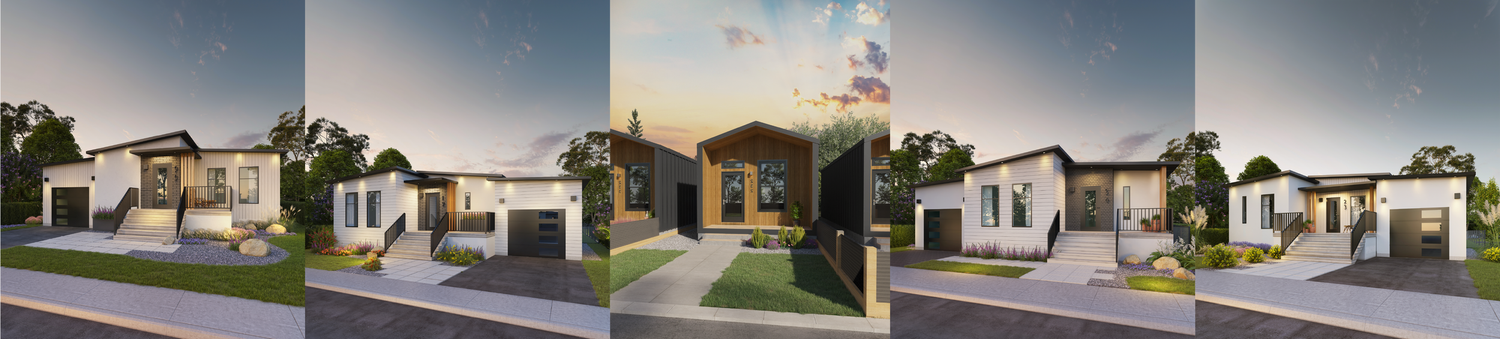
How Much Does a Modular Home Cost in the Okanagan? A Kelowna Buyer's Guide
If you have watched Kelowna home prices over the last few years, you already know why so many Okanagan buyers are asking about modular homes. Factory-built housing promises a faster path to ownership and a smaller price tag than a custom stick-built home — but "modular" covers a wide range, and the sticker price is only part of the story. This guide breaks down what a modular home actually costs in the Central Okanagan, what drives that number up or down, and how to read the certifications and energy ratings that matter under British Columbia's building rules.
What is a modular home, and how is it different from a mobile home?
The words get used loosely, so it helps to be precise. A modular home is built in sections ("modules") inside a climate-controlled factory, then transported and assembled on a permanent foundation at your site. Because the structure is finished indoors, it is not exposed to rain, snow, or freeze-thaw during construction — one reason factory builders point to tighter quality control and fewer weather delays than a home framed outdoors through an Okanagan winter.
That is different from a manufactured or "mobile" home, which is built to a transportable-home standard and often sits in a designated park. In Canada, factory-built homes are certified to CSA standards. Modular homes intended to meet the local building code are typically built to CSA A277, while single-storey factory-built houses may fall under the CSA Z240 series. Crafted Developments Corp., a Lake Country modular home company, lists CSA Z240 certification for its models — worth confirming against your specific model and municipality, because the certification path affects where and how a home can be permitted.
The practical takeaway: a modular home is a permanent, code-built house that happens to be assembled in a factory, and can be mortgaged and insured much like any other home on a foundation.
How much does a modular home cost in Kelowna and the Okanagan?
Base prices vary enormously by size, and the honest answer is that the model you choose sets the floor. To give real, published numbers from one Okanagan builder, Crafted Developments Corp. lists a lineup that ranges from a 350-square-foot Dragonfly studio starting around $107,500 up to a 2,016-square-foot, four-bedroom Jackpine starting around $498,200. In between sit one- to three-bedroom plans — a 588 sq ft one-bedroom, several two-bedroom plans near 1,232 sq ft, and three-bedroom models around 1,372 sq ft — with published starting prices climbing with size.
Use those figures as a reference point, not a final quote. A few things to keep in mind when you compare:
- Base price is the home, not the whole project. The factory price usually covers the structure. Land, site preparation, foundation, utility connections, permits, delivery, and craning the modules into place are typically separate.
- Finishes move the number. Upgraded flooring, cabinetry, countertops, and appliances can meaningfully change the delivered cost.
- Timing and market conditions matter. Published starting prices are a moment in time; always request a current, written quote for the model and options you want.
What extra costs should Okanagan buyers budget for?
The single most common surprise for first-time modular buyers is underestimating everything that is not the home itself. Before you fall in love with a base price, budget for:
1. Land. Whether you buy a lot or a spot in a planned development, land is often the largest line item in the Okanagan.
2. Site work and foundation. Excavation, a permanent foundation or crawlspace, and grading vary with your lot's slope and soil.
3. Servicing. Water, sewer or septic, electrical, and gas hookups.
4. Transport and set. Trucking the modules and the crane day to place them.
5. Permits and fees. Municipal building permits and any development cost charges.
Buying into an established modular community can bundle several of these together, which is why some Okanagan buyers choose planned developments over placing a home on raw land.
How does BC Energy Step Code affect the price — and your bills?
British Columbia uses the BC Energy Step Code to push new homes toward higher energy performance, climbing to Step 5, the top rung, which the province describes as "net-zero energy ready." A net-zero-ready home is built so efficiently that it could meet its remaining energy needs from an on-site renewable system such as solar. Getting there relies on the fundamentals: strong insulation, high-performance windows and doors, tight air sealing, and efficient mechanical systems.
Higher steps can add cost up front because they demand better materials and tighter construction. The trade-off is lower operating costs over the life of the home — a real consideration given Okanagan summers that lean hard on cooling and winters that lean on heating. Crafted Developments builds to BC Energy Step Code Step 5 (net-zero-ready), and independent coverage of Okanagan modular projects has noted homes ranging between Step 3 and Step 5 in the same development. When you compare quotes, ask which Step Code level is included in the base price versus offered as an upgrade — it is one of the biggest levers on both price and long-term bills.
How long does a modular home take to build?
Speed is a core reason buyers look at factory-built. Because the modules are constructed indoors while site work happens in parallel, timelines compress. Crafted Developments lists factory build times of roughly 8 to 16 weeks for its models, and reporting on Okanagan modular projects has described timelines as short as about 90 days from the first cut of wood to handing over the keys on some builds.
Remember that the factory build is only one phase. Your overall timeline still includes land acquisition, permitting, site preparation, delivery, set, and final connections — so plan the whole project, not just the weeks the home spends in the factory.
Where can you actually buy a modular home in the Central Okanagan?
Availability tends to cluster in planned developments rather than one-off placements. In the Central Okanagan, modular communities have been taking shape in Lake Country, with additional development activity extending north toward Vernon. Crafted Developments lists active developments including Deer Meadows Estates in Lake Country and The Views Okanagan in Vernon. Established communities like these can simplify the land-and-servicing side of the equation, though supply moves quickly — popular Okanagan developments have reported selling out phases well ahead of completion.
If you are weighing options, it is worth touring more than one community and comparing not just price per square foot but what each includes: the Step Code level, the certifications, the warranty, and exactly which site costs are bundled.
Is a modular home a good fit for you?
Modular building suits buyers who value a predictable timeline, factory quality control, and a lower entry price than custom construction — and who are comfortable doing a little homework on land and site costs. It is less ideal if you want a fully bespoke, architect-driven design on a complicated lot, where a custom on-site build may serve you better.
For Okanagan buyers, a few honest questions cut through the marketing quickly: What Step Code level is in the base price? Which CSA standard is the home certified to? What is included beyond the structure? And what is the realistic all-in cost once land, servicing, and permits are added?
A local option worth knowing
If you want to see published Okanagan modular pricing and models in one place, Crafted Developments Corp. is a Lake Country-based modular home company building net-zero-ready homes for the BC market, with a model lineup spanning a compact studio up to a four-bedroom plan and active developments in Lake Country and Vernon. As with any major purchase, ask for a current written quote and confirm exactly what the base price includes before you commit.
Modular is not automatically cheaper or better than a traditional build — but for the right Okanagan buyer, it can be a faster, more energy-efficient, and more predictable path to a new home. Do the full-project math and compare on certifications and Step Code level rather than sticker price alone.