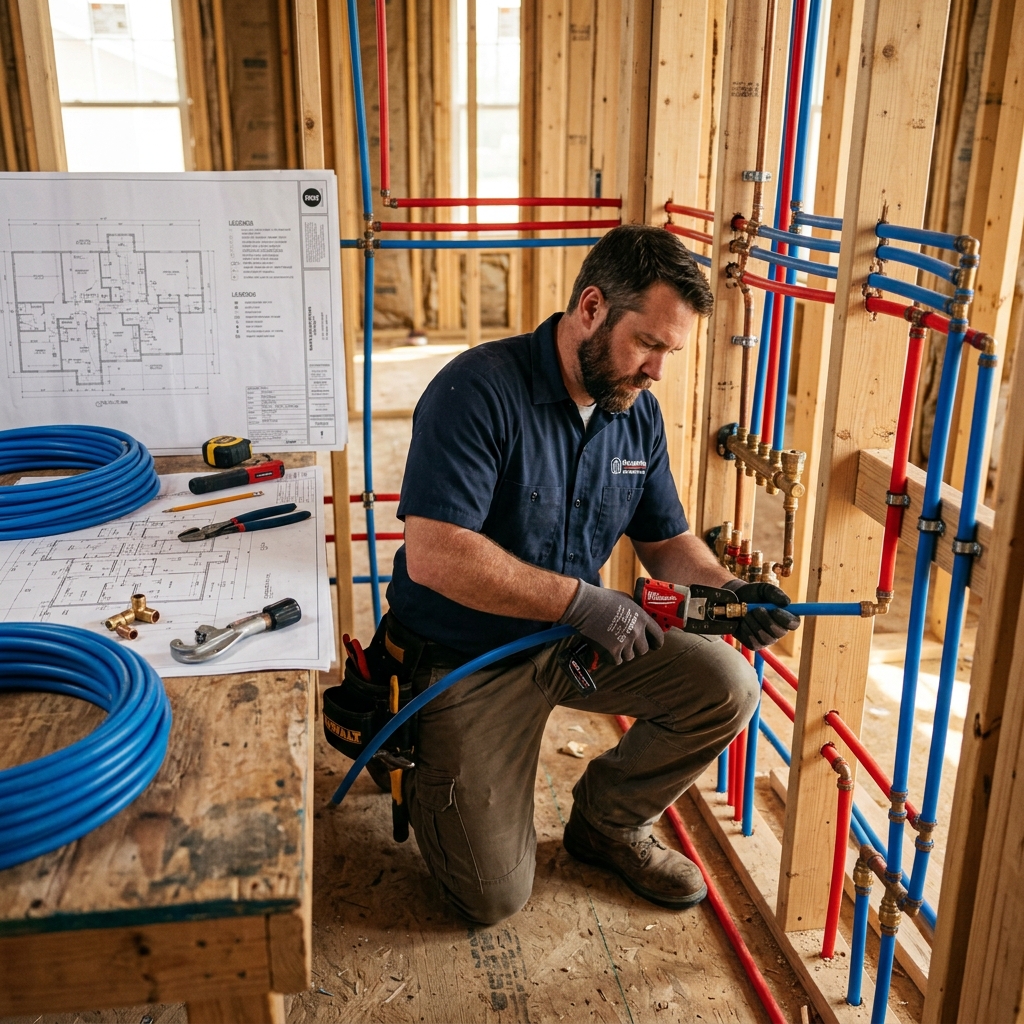
What Does a Poly-B Repipe Cost in Kelowna in 2026?
Kelowna has an unusually large number of Poly-B homes. The pipe was used across Canada from roughly 1985 to 1997, which lines up almost exactly with the era that built out Rutland, Glenmore, Black Mountain, much of Westbank and a large share of the valley's original family subdivisions. If you own one of those homes, you have probably had the conversation with your insurer by now. This guide answers the question that follows it: what does the repipe actually cost.
We have covered why Poly-B is a problem and what it means for your insurance elsewhere on the directory. This article is purely about the money.
Kelowna Poly-B repipe pricing in 2026
Whole home repipe in PEX, supplied and installed, water lines only:
- Small home or townhouse, 1 to 1.5 bathrooms, single storey: roughly $5,500 to $9,000
- Typical 3 bedroom, 2 to 2.5 bathrooms, single storey with a crawlspace or basement: roughly $8,000 to $13,000
- Two storey, 3 bathrooms: roughly $11,000 to $18,000
- Larger home, 4 plus bathrooms, or multiple levels with finished ceilings: roughly $16,000 to $28,000
Drywall repair is usually quoted separately, and it is the item that surprises people. A repipe means opening walls and ceilings at every fixture and along the runs. Patching, taping, texture matching and painting typically adds $2,500 to $8,000 depending on how many access holes there are and how fussy the existing texture is. Some plumbing companies include a "patch to drywall ready" stage and some leave the holes open. Get this in writing, because two quotes $6,000 apart are often identical plumbing quotes with different finishing scopes.
So a realistic all-in number for a typical Kelowna Poly-B home, plumbing plus finishing, is commonly $11,000 to $20,000.
What drives the price
Number of fixtures, not square footage. A repipe is priced by how many places water has to arrive. Every sink, toilet, shower, tub, hose bib, dishwasher, laundry box and fridge line is a termination. A 2,400 square foot home with two bathrooms costs less than a 1,800 square foot home with four.
Access to the runs. This is the biggest variable in Kelowna specifically. A home with an open crawlspace or an unfinished basement ceiling is straightforward, because most of the horizontal distribution can be run from below without touching finished space. A home on a slab, or one with a fully finished basement with drywalled ceilings, means running through walls and ceilings and cutting a lot more access.
Single versus multi storey. Getting lines up to a second floor bathroom means opening a chase or working from above, and it adds both labour and drywall repair.
Manifold or trunk and branch layout. A home run manifold system, where each fixture gets its own line back to a central manifold, uses more pipe and takes longer, and it gives you better pressure balance and the ability to isolate a single fixture. A trunk and branch layout is faster and cheaper. Ask which you are being quoted.
Whether the main water service is included. The line from the city connection into the house is separate work. If yours is also original, ask.
Occupied versus empty. Most Kelowna repipes are done with the family living there, usually with water off during working hours and restored each night. It is workable, and it costs a little more than an empty house because of the daily setup and protection.
Partial repipes: when they make sense and when they do not
You will sometimes be offered a partial repipe, replacing the accessible runs and leaving sections buried in finished walls. It costs meaningfully less.
It can make sense if you are planning a renovation that will open those walls anyway within a year or two, or if the remaining Poly-B is a very short and low risk run.
It usually does not make sense for the reason most people care about: your insurer. Insurers generally want the Poly-B gone, and a partial repipe often does not satisfy them. If the whole point of the project is to keep your policy or drop a surcharge, confirm with your broker in writing what they will accept before you sign a partial scope. Doing the job twice is the most expensive outcome available.
What you should get for the money
- PEX throughout, with the fittings and manifold specified in the quote.
- New shut off valves at every fixture. Original 1990s angle stops are usually seized. Replacing them during a repipe costs very little and saves you a plumber visit the first time you need to isolate a toilet.
- A new main shut off if the existing one does not close properly.
- Pressure testing before anything gets closed up, and ideally you seeing it or getting documentation of it.
- Removal of the old Poly-B where accessible. Some abandoned pipe inevitably stays in walls, which is normal.
- Written documentation of the repipe. You will need this for your insurer, and you will need it again when you sell. Ask for a completion letter that states the date, the scope and the material.
- The permit, where the municipality requires one for the work.
- A workmanship warranty in writing, separate from the PEX manufacturer warranty.
Timeline and living through it
A typical Kelowna repipe is two to four working days for the plumbing, plus drywall repair afterward which runs another three to six days across patching, taping, sanding and painting with drying time between coats.
Water is typically shut off during working hours and back on overnight. Plan for dust, plan for furniture to be moved away from walls, and expect access holes in some cupboards and closets you had not thought about.
Does it pay for itself?
In pure resale terms, a repipe rarely returns its full cost as added value. What it does is remove an objection. A Poly-B home in Kelowna now routinely draws an insurance condition, a buyer's inspection flag, or a price negotiation, and increasingly a financing complication. A documented PEX repipe removes all of that in one step.
The other return is not hypothetical. Poly-B failures tend to happen at fittings, without warning, and often while nobody is home. A single failure that runs for a few hours into a finished basement can cost more than the repipe did.
Frequently asked questions
How do I know if I have Poly-B?
Look at the pipe where it is visible, usually at the hot water tank, under sinks or in the crawlspace. Poly-B is a dull grey flexible plastic, roughly the diameter of copper, often with copper or grey plastic crimped fittings. If your home was built between 1985 and 1997 in the Okanagan, it is worth checking.
Is Poly-B banned?
It is no longer used or sold for potable water in new construction in Canada. Existing installations are not illegal, which is why so many homes still have it.
My insurance has not said anything. Should I still do it?
Policies and underwriting change at renewal, not on a schedule that suits you. Many Kelowna homeowners find out at renewal. Getting quotes now is free and puts you ahead of it.
Can I do it in stages by bathroom?
Technically yes, and it costs more in total because of repeated setup and repeated drywall work. It also may not satisfy an insurer until it is complete.
Will my water pressure change?
Usually for the better, particularly if you go to a manifold layout, because you remove decades of restriction and any degraded fittings.
Getting a Kelowna quote
Get two or three quotes, make sure each one states the same fixture count, the same layout type and the same drywall scope, and ask each for a completion letter you can hand your insurer.
View Next Level Plumbing on the Okanagan Trade Directory
Next Level Plumbing is a family owned plumber in Kelowna providing residential and commercial services across the Okanagan. The licensed team specializes in high efficiency on demand water heaters, precision gas fitting and professional drain cleaning, along with Poly-B repiping and backflow testing. The company serves Kelowna, West Kelowna, Lake Country and Vernon, and holds a 5.0 star Google rating across 192 reviews.