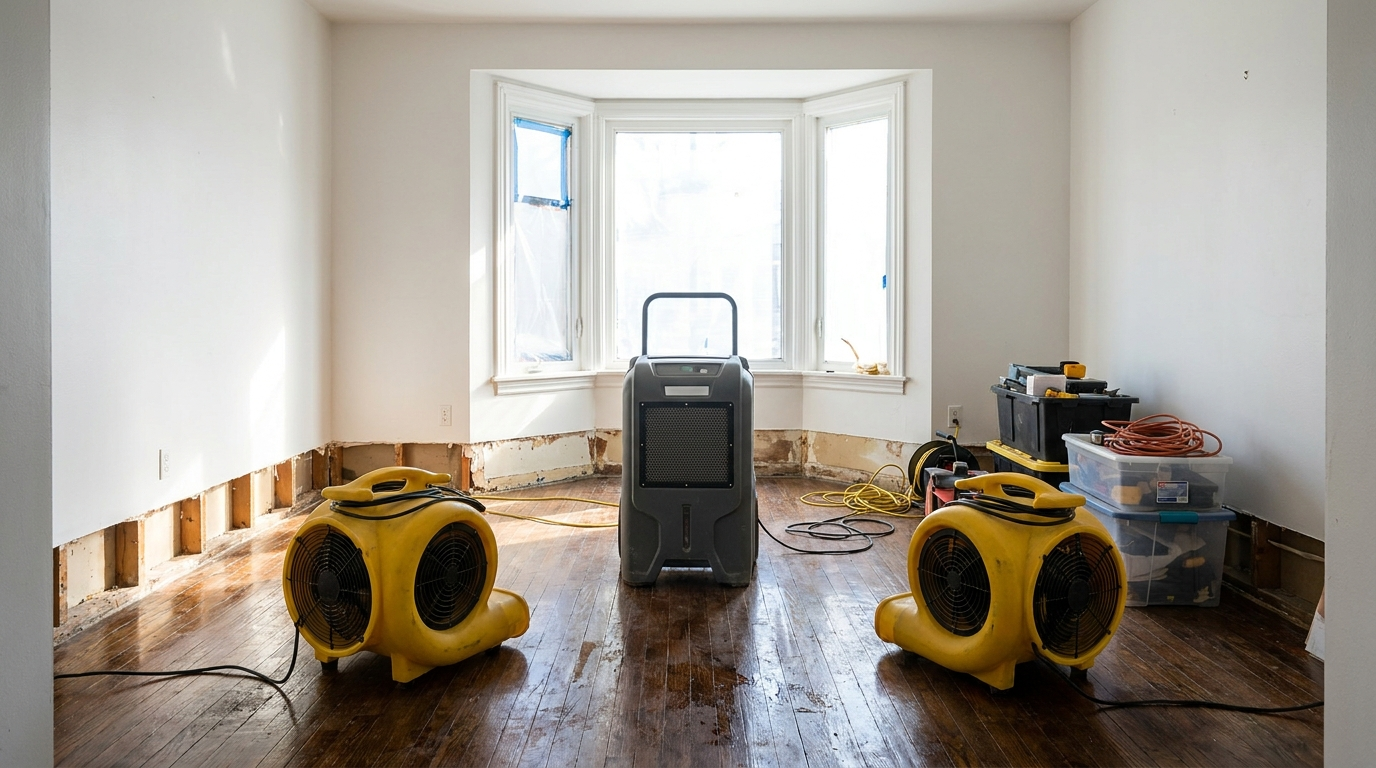
A burst supply line, a failed water heater, an overflowing washing machine, a spring storm that pushes water into a basement — water damage rarely announces itself politely. One minute the house is fine, the next there's water spreading across a floor and soaking into walls. What you do in the first day or two makes an enormous difference to how big, expensive, and disruptive the repair becomes. Here's a calm, practical walkthrough for Okanagan homeowners.
The first hour: stop the water and stay safe
Before anything else, deal with the source and the hazards.
- Shut off the water. If it's a plumbing failure, close the nearest shutoff valve, or the main shutoff for the house if you can't isolate it. Stopping the flow is priority one.
- Mind the electricity. Water and power don't mix. If water is near outlets, the panel, or has reached the ceiling below, keep out and shut off power to the affected area at the breaker — but don't wade into standing water to reach a panel. If in doubt, call an electrician or your utility.
- Protect people and pets first, belongings second. Move what you can lift out of the wet zone, but don't put yourself at risk over furniture.
The first hours to first day: document, then dry
Two things need to happen quickly, and they run in parallel.
Document everything for insurance. Before you clean up, photograph and video the damage from every angle — standing water, soaked walls and flooring, affected contents. Call your insurer to open a claim and ask what they need. Good documentation up front prevents disputes later and often shapes what's covered.
Start removing water and moving air. The single biggest factor in how bad water damage gets is *how fast it dries*. Mop and extract standing water, open windows if the weather's dry, and get fans and a dehumidifier running. The Okanagan's dry summer air is an ally here, but don't be fooled — water wicks up inside walls and under flooring where a fan on the surface never reaches.
Why speed matters: the 24–48 hour mould window
This is the part homeowners most often underestimate. Given moisture, warmth, and organic material — and drywall paper, wood framing, and insulation are all organic food sources — mould can begin to establish within roughly a day or two. Once it's into wall cavities and under floors, remediation gets far more involved and costly than the original water event.
That's why "it looks dry" is not the same as "it is dry." Surfaces can feel fine while the insulation behind the wall and the framing stay saturated. Professionals use moisture meters to find hidden wet zones and confirm materials are actually dry before closing anything back up. Racing the clock on drying is the whole game.
What has to come out vs. what can be saved
Not everything wet gets torn out — but some things should. A restoration pro assesses each material:
- Drywall. Lightly dampened drywall can sometimes be dried in place; drywall that was soaked, especially near the floor, is typically cut out (a "flood cut" a foot or two up the wall) so the cavity behind can dry and be inspected.
- Insulation. Wet batt insulation loses its value and holds moisture against the framing, so saturated insulation usually comes out. The vapour barrier behind it often has to be opened up too, since it can trap water in the wall.
- Flooring. Tile may survive; laminate and many engineered floors swell and delaminate; carpet and its underpad are often removed when soaked. Subfloor is checked for moisture.
- Framing. Solid wood framing can usually be dried and saved if it's addressed quickly — which is exactly why fast response matters.
The goal is to remove what's compromised, dry what remains down to a verified moisture level, and only then rebuild.
What "restoration" actually rebuilds
Once the structure is dry, restoration is essentially a small, focused rebuild — and it takes a contractor who can do the whole sequence, not just one trade. On a typical water-damage repair that means:
1. Demolition of the damaged drywall, insulation, and flooring that had to come out.
2. Drying and verification that the cavity and framing are back to a safe moisture level.
3. Reframing of any structural pieces that couldn't be saved, including steel-stud work where appropriate.
4. New insulation and vapour barrier installed correctly so the wall performs and doesn't trap moisture.
5. Drywall, taping, and finishing to match the surrounding surfaces — including texture matching so the repair disappears.
6. Painting to blend the restored area into the room.
Hiring one contractor who covers that full chain — demo through paint — avoids the gaps and finger-pointing that happen when a job is split across several trades who each show up weeks apart.
Choosing a restoration contractor in the Okanagan
Look for someone licensed and insured who can handle both the tear-out and the rebuild, and who'll document conditions for your insurer. M Cox Construction is a Kelowna-based, owner-operated firm that handles restoration for flood-, fire-, and storm-damaged buildings, and — because they also do drywall and taping, steel-stud framing, insulation and vapour barrier, and interior and exterior painting — they can carry a water-damage repair from demolition right through to a finished, painted wall. Owner-operated by Marc Cox and licensed and insured, they serve Kelowna, West Kelowna, Lake Country, Vernon, Peachland, Summerland, and Penticton. You can see their services and reach out through their Okanagan Trade Directory profile.
The bottom line
Water damage is one of those problems where the first two days decide most of the outcome. Stop the water, keep yourself safe, document for insurance, and get things drying fast — then bring in a licensed contractor who can find the hidden moisture and rebuild what came out. Move quickly and a scary morning becomes a manageable repair. Wait too long, and a dry-looking wall can hide a much bigger, mouldier problem behind it.