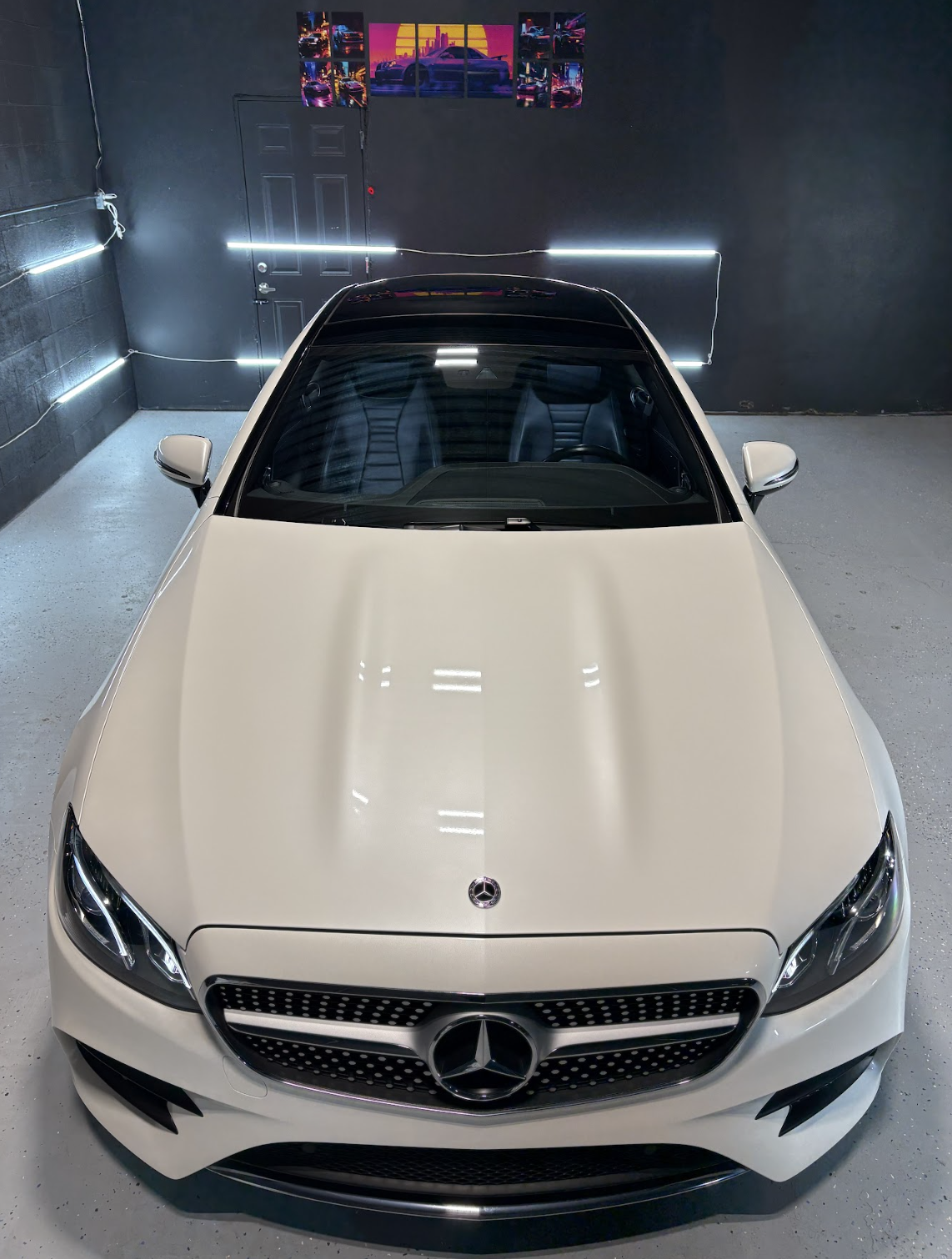
If you've shopped detailing services in the Okanagan, you've seen the two services advertised side by side: paint correction and ceramic coating. Often the same shop offers both, often they're priced as a package, and most car owners have no clear sense of what the difference actually is or why the pairing matters.
Here's the short version:
- Paint correction *fixes* what's wrong with your paint.
- Ceramic coating *protects* what's right with your paint.
You do them in that order. Doing one without the other is usually a mistake. Here's the longer explanation, written for someone who's about to spend real money on the work and wants to understand what they're getting.
What paint correction actually is
Every vehicle that has been driven, washed, or parked outdoors for more than a few months has accumulated microscopic damage to its clear coat. This damage falls into several categories:
- Swirl marks: fine circular scratches from improper washing technique (the rotary motion of a dirty wash mitt is the most common culprit).
- Hard-water spots: mineral deposits from sprinklers, rainwater, or improper drying that have etched into the clear coat.
- Bird droppings, sap, and bug residue: organic material whose acids have begun to etch the paint.
- UV oxidation: a microscopic chalky layer that develops on the surface of older clear coats from years of sun exposure.
- Road tar, fallout, and contamination: industrial fallout that has chemically bonded to the paint surface.
Paint correction is a multi-stage process that removes all of these defects. The technician starts with a thorough wash and decontamination, then uses a series of progressively finer polishing compounds with a dual-action polisher to mechanically remove the damaged surface layer of clear coat, one micron at a time. The result, done correctly, is paint that looks better than it did when the car left the dealership — not because it's "shinier" but because the clear coat is now optically perfect, with no light-scattering surface defects to dull the underlying color.
A full multi-stage paint correction on a daily-driven Okanagan vehicle typically takes 8–14 hours of skilled labor. It is not a quick job, and shortcuts in the process show up immediately in the result.
What ceramic coating actually is
Ceramic coating is a liquid polymer that, once applied to the corrected paint and cured, forms a permanent (or semi-permanent, depending on the product) hard glass-like layer bonded chemically to the clear coat. The coating provides:
- Hydrophobic water behavior: water beads and rolls off, taking dust and contamination with it.
- Chemical resistance: bird droppings, tree sap, road salt, and industrial fallout can sit on the coating for far longer without etching into the paint underneath.
- UV protection: significantly reduced rate of clear-coat oxidation from sun exposure — important in the Okanagan, which gets more annual sun than most of the country.
- Scratch resistance (limited): a ceramic coating won't make your paint scratch-proof, but it raises the hardness of the surface layer so that minor contact (a sleeve brushing the door, a soft wash mitt) doesn't leave visible marks the way it would on uncoated paint.
- Easier washing: dirt doesn't bond to a ceramic-coated surface the way it bonds to bare clear coat. Routine washes go faster and produce a better result with less risk of swirl-mark-inducing contact.
Quality ceramic coatings last anywhere from 2 years (entry-level consumer products) to 7+ years (professional-grade products applied by certified installers). The cost varies accordingly.
Why you do them together
Here's the key insight that most car owners miss: ceramic coating locks in whatever the surface of your paint looks like at the moment it's applied. All the swirl marks, water spots, and contamination present on the day of the coating get sealed under the ceramic layer, and now they're permanent for the life of the coating.
This is why a quality detailer will refuse to apply a ceramic coating to a vehicle that hasn't had paint correction first. Coating uncorrected paint is, in the industry's standard phrase, *"sealing in the damage."* You've now made the imperfections permanent and you've paid for the privilege.
The correct sequence is always:
1. Wash and decontaminate (clay bar, iron remover, chemical strip).
2. Paint correction (one to three stages depending on the paint's condition).
3. Surface prep (panel wipe to remove any polishing oils — coatings won't bond to oily surfaces).
4. Ceramic coating application (controlled environment, panel-by-panel application, careful cure time).
5. Inspection and final cure (24–48 hours indoors before exposure to water).
Each step is dependent on the one before it. Skipping any of them compromises the result.
What to ask before booking
When you call a detail shop offering this service combination, the questions worth asking:
1. *What's your paint correction process? How many stages, and what compounds?* (A vague answer is a flag. A real shop will walk you through their process in detail.)
2. *What ceramic coating product do you use, and are you certified by the manufacturer?* (Premium products — CQuartz Professional, Gtechniq, Modesta, Feynlab, etc. — only sell to certified installers. The certification is a meaningful quality signal.)
3. *How long does the vehicle need to be in?* (For a full correction-plus-coating package, expect 2–3 days. Anything quoted in less than two days is being rushed.)
4. *What's the warranty?* (Quality professional coatings come with a manufacturer-backed warranty registered to the vehicle's VIN. The warranty is meaningful protection if the coating fails prematurely.)
A reputable detailer answers all four questions clearly and shows you previous work. A shop that gets vague on any of them is one to keep shopping.
Whether it's worth doing
For a daily-driven Okanagan vehicle that's spending years on hot summer roads, exposed to UV all day in parking lots, and getting hit with road salt and de-icer through winter, the answer for most owners is yes — particularly if you plan to keep the vehicle for five or more years. The correction-plus-coating package, done right, looks dramatic for the first month and pays off in reduced wash time, dramatically slower paint aging, and significantly better resale value when the time comes.
For a lease return in 18 months, probably not worth it. For a vehicle you actually own and want to keep looking right for the long haul, absolutely.
About Kai-Den Detail Pro
Kai-Den Detail Pro is a Kelowna auto detailing operation specializing in multi-stage paint correction, professional ceramic coating, and full-service detailing. Located on Enterprise Way in Kelowna's east industrial corridor — the same automotive services strip that hosts the city's body shops and specialty auto operators. 5.0★ Google rating.
Contact: Albert · (250) 863-4812
Address: 2670 Enterprise Way, Kelowna, BC
Website: kai-dendetailpro.ca