Three Daylighting Upgrades That Drop Okanagan Indoor Temperatures Without AC
The Okanagan summer is one of the hottest in Canada. Long sunlight hours, low humidity, and a sun angle that pushes through south- and west-facing windows for most of the afternoon mean that interior temperatures in a typical Kelowna home can climb 10–15°F above outdoor ambient during a July afternoon — even with central air running.
The reflexive response is more air conditioning. Bigger system, more zones, longer run times. The electrical bill in July becomes legendary.
There's a quieter response that most homeowners haven't heard about — three categories of sun-management upgrades that, installed together, can drop interior temperatures by enough to make a meaningful difference in both comfort and AC load. None of them require electrical work beyond a low-voltage motor circuit, none require rewiring, and all three have been installed in Okanagan homes for two decades with proven results.
Here they are.
1. Tubular skylights (Solatube)
A traditional skylight is essentially a hole in your ceiling with glass over it. It admits a flood of light during the day — but also a flood of heat in summer and cold leakage in winter, and it's expensive enough to install that most homeowners only have one or two.
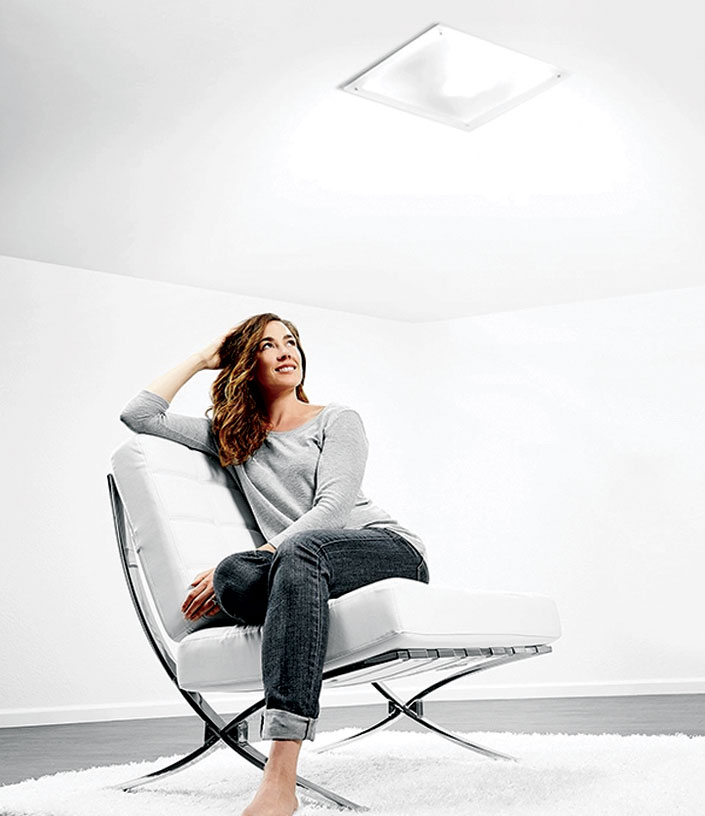
A tubular skylight is something different. It's a 10- or 14-inch reflective tube that runs from a small dome on the roof, down through the attic, to a diffuser in the ceiling of the room below. The light is captured at the roof, bounced through the tube with near-zero loss (modern reflective coatings preserve 99%+ of the incoming light), and emerges in the room as a soft, daylight-balanced glow that looks remarkably like a recessed LED fixture — except it's free sunlight, available from sunrise to sunset.
What this lets you do that matters for temperature:
- Turn off the overhead lights all day. A well-placed tubular skylight provides full task-level lighting for a hallway, bathroom, walk-in closet, or interior kitchen during all daylight hours. That's hours per day of incandescent or LED lighting load you can simply turn off — and lighting load becomes heat load when you're running AC against it.
- Replace a traditional skylight without the thermal penalty. Tubular skylights are insulated along the tube run, sealed at both the roof dome and the ceiling diffuser, and have a tiny fraction of the heat-loss/heat-gain surface area of a conventional skylight.
The most common Okanagan installation pattern is to put tubular skylights in interior rooms that don't have natural light — hallways, bathrooms, laundry rooms, walk-in pantries — where they replace the daytime electrical lighting completely.
2. Retractable patio awnings
The single biggest source of summer interior heat gain in most Okanagan homes is the direct sun hitting south- and west-facing windows and patio doors between 11am and 6pm. A retractable awning installed above those windows or across a patio handles this directly: when the sun is hitting hard, you extend it; when you want the warmth in spring and fall, you retract it.
The difference for interior temperature is significant. A 12-foot retractable awning shading a south-facing patio door can drop the interior temperature of the adjacent living space by 5–8°F during peak afternoon hours, with no AC running at all. Stacked with central air running, the AC compressor cycles dramatically less frequently because it isn't fighting active solar gain.
Modern retractable awnings extend and retract via a motorized arm system, with optional wind/sun sensors that automatically retract the awning in high wind or extend it when sun intensity passes a threshold. The fabric is acrylic, UV-stable for 10+ years, and available in widths up to about 25 feet in a single span. Common Okanagan installations are over patios, hot tubs, decks, and ground-floor south-facing windows.
European brands like STOBAG dominate the higher-end of this market because their hardware is engineered for long service lives — important in the Okanagan where the awning is extended frequently across a long sunny season.
3. Motorized window coverings
The third piece — and the one that ties the system together — is motorized interior window shading. Cellular shades, roller shades, and Roman shades all come in motorized versions now, controlled via remote, wall switch, smartphone app, or scheduled automation.
The temperature impact comes from two effects:
1. Direct solar blocking. A closed cellular shade blocks 80–90% of incoming solar radiation. On a south or west window between noon and 6pm in July, that's enormous.
2. Insulating air pocket. A double-cell cellular shade creates two insulating air gaps between the window glass and the room. The R-value of the shade-plus-air-gap system is significantly higher than the window alone, dropping both summer heat gain and winter heat loss.
The motorization matters because the practical reality of manual shades is that nobody actually closes them at the right time of day. A wall-switched or scheduled motorized shade closes itself at 11am and reopens at 6pm without anyone thinking about it. That consistency is where the real temperature impact comes from.
The brands worth knowing about — Graber and Maxxmar in the mid-to-high tier, Hunter Douglas in the premium tier — all offer motorized versions of essentially every shade style they make.
Why all three together is the right play
Individually, each upgrade helps. Together, they compound. A tubular skylight lets you turn off the daytime lights. A retractable awning blocks direct solar gain at the building exterior before it ever reaches the window. Motorized interior shades catch what gets through. The cumulative result, in Okanagan homes that have done all three, is interior summer temperatures that stay comfortable with the AC running on a much lower duty cycle than it would otherwise.
The math at the electrical meter is straightforward: less lighting load + less AC load = significantly lower July and August bills. The math for comfort is even more straightforward: you stop dreading the south-facing rooms in the afternoon.
For Okanagan homeowners thinking about how to make summer 2026 more comfortable without a bigger AC bill, these three upgrades are the conversation worth having before the heat arrives.
About Solar Centre
Solar Centre is a Kelowna-based daylighting and shade specialist serving the Okanagan since 2004. A Solatube Premier Dealer and Somfy Expert Dealer, the company installs Solatube tubular skylights and Solar Star attic fans, plus a full portfolio of STOBAG retractable awnings, Mirage retractable screens, and Graber/Maxxmar motorized window fashions. 5.0★ across 50 Google reviews. (Note: despite the name, Solar Centre is a sun-management specialist, not a photovoltaic solar electricity contractor.)
Contact: Fred · (778) 363-1446
Address: 16-1771 Cooper Rd, Kelowna, BC
Website: solarcentre.ca