Why Cracked Driveways on Okanagan Slopes Fail Faster Than the Rest — and the Resurfacing Approach That Actually Holds Up in Glenrosa, Glenmore, and the Naramata Bench
If you live on a hillside Okanagan lot — Glenrosa, Lakeview Heights, Casa Loma, Glenmore, Dilworth Mountain, Kettle Valley, Naramata Bench, West Bench, the upper Mission, Wiltse, anywhere with a gradient — your driveway is failing in a particular way that flat-lot driveways don't.
It cracks first along the slope lines. The edges spall and crumble. There's a pattern of water staining and salt damage concentrated along the lowest sections. The crowns of the slab fade faster than the bases. The seams between sections of slab open up wider on hillside driveways than they ever do on a flat suburban one.
This is not bad luck or bad concrete. It's physics. Sloped driveways take a category of stress that flat driveways don't, and most coating systems that survive on flat driveways fail on a slope within a fraction of their advertised lifespan. Here's what's actually happening and what to do about it — including the resurfacing approach that does hold up.
The four stresses sloped driveways take that flat ones don't
1. Concentrated runoff and freeze-thaw at the same low points
A flat driveway sheds water roughly evenly across its surface. A sloped one channels water down the gradient, with the volume increasing toward the bottom. In an Okanagan winter, that concentration of water at the low sections of the slab is where freeze-thaw damage is worst.
The freeze-thaw cycle is unusually severe on slopes for a specific reason: water doesn't just sit on the surface, it migrates into the *seams and cracks* of the slab via the slope itself, then freezes and expands at the lowest accessible point. Each cycle widens the seam or crack a little. After a decade of winters, the same cracks that started as hairlines at the top of the slope are quarter-inch fissures at the bottom — and the failure radiates upward over time.
2. Snowplow scraping concentrated at the same edges, every winter
Plowing a sloped driveway is harder on the surface than plowing a flat one. The blade catches at the same edges and high points each pass, because the operator is fighting gravity on the way down and traction on the way up. The result is concentrated wear on the slab's high points and edges — exactly the locations where spalling, micro-cracking, and rebar exposure show up first.
Metal snowplow blades on rigid surfaces are the worst combination. Plastic-edge blades are gentler. So is letting the snow melt rather than scraping aggressively. But on a steep Okanagan driveway in February, both options are usually impractical, and the slab takes the damage instead.
3. Differential thermal expansion along the slope
A long sloped driveway sits across a thermal gradient. The top of a south-facing driveway in the upper Mission gets full sun and reaches +50°C surface temperature in July. The bottom, often shaded by the home itself, sits 10-15°C cooler in the same hour. The slab expands and contracts at different rates across its length, and the resulting shear forces fracture rigid finishes (stamped concrete, painted concrete, rigid epoxy coatings) along the same control joints every year.
A flat suburban driveway sees the same temperature across its whole surface — the stress is distributed evenly. A sloped one is being pulled in two directions at once.
4. Salt scaling concentrated where the brine pools
Road salt and de-icing chemicals that wash down a sloped driveway pool at the bottom — at the gutter line, where the driveway meets the city sidewalk or street. That concentrated brine attacks the surface chemistry of the concrete more aggressively than the diluted salt that lands on the upper sections. The lower 6-10 feet of most sloped Okanagan driveways shows visibly more salt damage than the rest.
ASTM C672 — the standard test for concrete scaling resistance under freeze-thaw with de-icing chemicals — explicitly recognizes that surface chemistry, not just structural strength, determines lifespan in this environment. Standard residential concrete poured before air-entrainment became standard in BC (mid-1990s) routinely fails C672 within 10-15 years on a sloped driveway with regular winter salt exposure.
Why most coating systems fail on sloped Okanagan driveways
A short list of products commonly applied to driveways, and the failure modes specific to sloped substrates:
| Product | Typical lifespan (flat) | Typical lifespan (slope) | Failure mode on slope |
|---|---|---|---|
| Concrete sealer (acrylic) | 2-3 years | 1-2 years | Wears off fast at high traffic points, pools in low spots |
| Painted concrete | 2-3 years | 1 year | Peels at high points, lifts where water migrates underneath |
| Stamped concrete overlay | 8-12 years | 5-7 years | Cracks along the same control joints as the substrate |
| Acrylic flake coating | 5-7 years | 3-5 years | UV failure of decorative chips, peeling at edges |
| Polyaspartic / epoxy flake | 8-10 years | 6-8 years | Edge lift, salt damage at the low end |
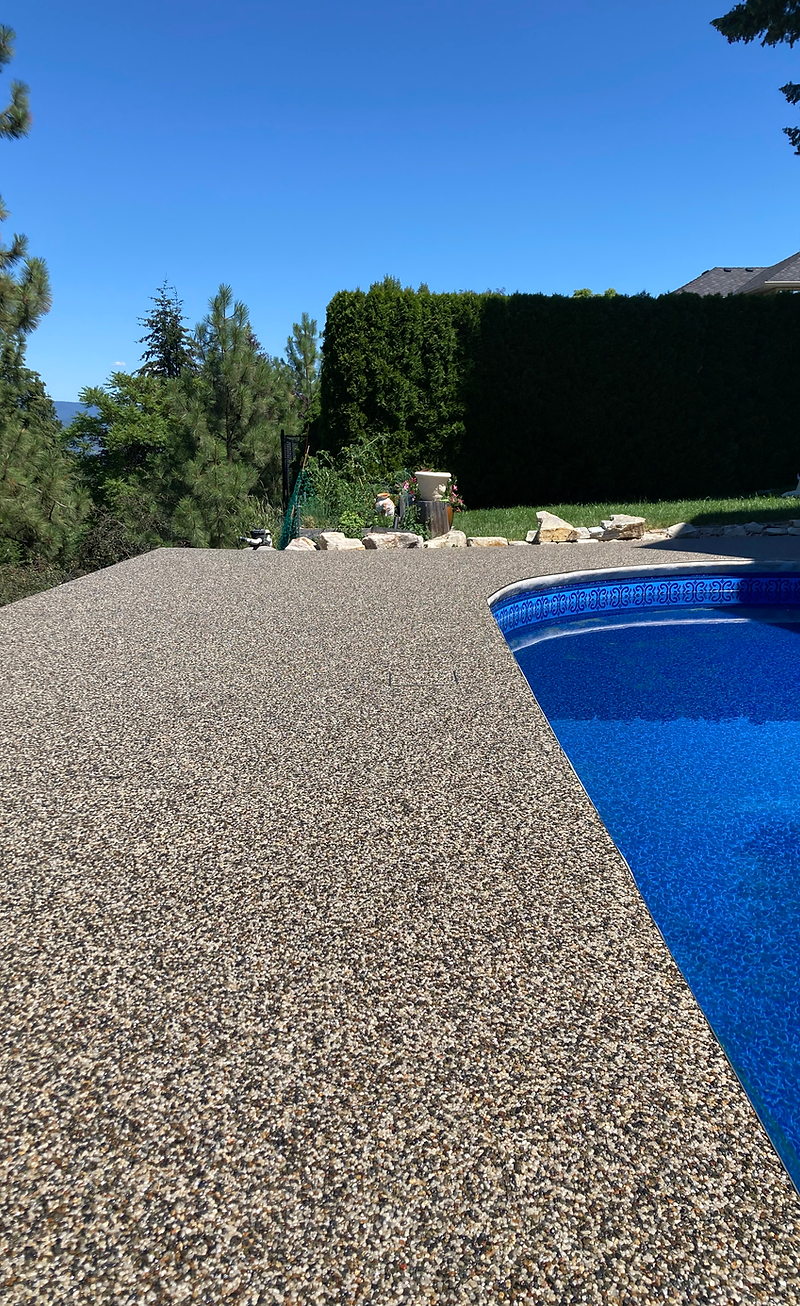
| Sierra Stone aggregate system | 20-25 years | 20-25 years | Engineered for slope conditions; flexible epoxy matrix accommodates differential expansion |
| Asphalt patch | 5-8 years | 3-5 years | Cracks at the same seams, softens in summer heat |
The pattern is consistent: most coating systems lose 30-50% of their advertised lifespan on a sloped substrate. The exception is the natural-stone aggregate system in a flexible epoxy matrix — because the flexible matrix is what accommodates the differential thermal expansion that breaks rigid finishes.
What a Sierra Stone driveway install actually does differently
Three engineering choices in the system that matter specifically for sloped driveways:
1. Flexible industrial-grade epoxy matrix
The epoxy that holds the natural-stone aggregate is not a rigid material like cured concrete. It is engineered with measured elastic modulus to flex under thermal expansion and freeze-thaw stress without micro-fracturing. On a slope, this means the surface can move with the slab below it rather than cracking along the same lines.
For comparison: rigid stamped concrete overlays are essentially cement-based, with similar rigid-material behaviour to the concrete underneath. They crack along the same seams because they share the underlying material's lack of flex.
2. UV-stable urethane topcoat formulated for Okanagan exposure
The topcoat is the wear layer that takes the snowplow blade, the road salt, the tire scrubbing, and the 2,000+ annual hours of direct sun. Industrial urethane formulated for sustained UV exposure has a service life measured in decades, not years — and unlike acrylic sealers, it does not chalk, peel, or pool.
The topcoat is also re-applied at the 12-15 year mark to extend the surface indefinitely. That recoat costs roughly 20-25% of the original install and is the only maintenance the system requires.
3. Mechanical surface profile (CSP-3 to CSP-4) for bond integrity
A coating's bond to the substrate is the single failure point on a sloped driveway. Water that migrates under a poorly-bonded coating causes lift, peel, and freeze-damage at the bond layer. The Sierra Stone installation process includes mechanical surface preparation — grinding or shot-blasting to expose a clean, slightly-porous concrete profile (CSP-3 to CSP-4 per ICRI standards) — that the epoxy primer can mechanically bond to.
This prep step is what separates a 25-year install from a 5-year install. Cheap coating jobs skip it. Sierra Stone treats it as the day-one priority. We covered this in the 3-day install walkthrough article.
What it costs on a typical sloped Okanagan driveway
For an 800 sq ft driveway (a common Glenrosa, Lakeview Heights, or Naramata Bench size — longer than a typical suburban driveway because the slope adds linear feet):
| Approach | All-in 2026 cost | Expected lifespan on slope | 25-year total |
|---|---|---|---|
| Sealer reapplication every 2 years | $1,800-$3,000 per cycle | 2 years | $22,000-$37,000 over 25 years |
| Repaint every 1-2 years | $1,200-$2,400 per cycle | 1-2 years | $15,000-$30,000 over 25 years |
| Asphalt patch + reseal every 5 years | $4,000-$7,000 per cycle | 5 years | $20,000-$35,000 over 25 years |
| Stamped concrete overlay | $14,000-$20,000 | 5-7 years | $42,000-$60,000 over 25 years |
| Full concrete replacement | $12,000-$22,000 | 12-15 years before resurface needed again | $24,000-$44,000 over 25 years |
| Sierra Stone aggregate | $7,200-$11,200 | 20-25 years | $9,000-$13,500 over 25 years |
Even at the cheapest end of every alternative, the Sierra Stone system has the lowest 25-year cost — because most alternatives need repeating multiple times across a quarter-century lifespan, and the maintenance compounds.
When even Sierra Stone isn't the right answer for your slope
Honesty matters. Three conditions on sloped Okanagan driveways where a coating system isn't the right call and the underlying slab needs structural work first:
1. Visible vertical displacement at a control joint — one slab section has dropped half an inch or more relative to the next. The substrate has settled and the coating layered on top will eventually telegraph the failure through.
2. Frost heave that has lifted sections of the slab visibly off-grade — the slope itself has changed shape, water now pools where it didn't before, and the coating won't restore the original grade.
3. Through-cracks wider than 1/4 inch with separation visible at the edges — the slab is no longer monolithic and needs structural repair before any decorative resurface.
For these structural cases, slab-lifting specialists like Wise Cracks (covered in our Kelowna concrete repair companies comparison) can lift the slab back to grade. Once that's done, a Sierra Stone coating can go on top.
A reputable installer tells you straight which category your slope falls into. Sierra Stone's free in-home estimate includes a structural assessment of the slab before any pricing conversation.
Three questions to ask before booking a sloped driveway resurfacing project
1. "Will the coating system flex with thermal expansion across the slope?" A reputable contractor will explain the elastic modulus of their matrix. A flexible system is engineered for slope; a rigid system is not.
2. "What mechanical surface prep are you doing before the coating goes on?" If the answer is "we'll pressure wash it," the bond layer is at risk on a slope. Mechanical grinding or shot-blasting to ICRI CSP-3 to CSP-4 is the standard for long-lifespan installs.
3. "What's the warranty on adhesion specifically?" Most coating failures on slopes happen at the bond layer, not the surface. The adhesion warranty is the practical guarantee. Look for 5+ years on adhesion, not just on "surface quality."
Preview the finish on your actual driveway before booking
If your slope is a resurfacing candidate, Sierra Stone's free AI visualizer lets you upload a photo of your driveway, brush a mask over the area, pick from twelve stone finishes, and see a photorealistic AI render in about thirty seconds. Free, instant, unlimited variations. The only stone-coating contractor in BC offering it.
This matters more for driveways than for any other surface, because curb appeal is what drives ROI on the project. Picking the wrong colour on a driveway is visible from the street every time you come home.
Bottom line
Cracked driveways on Okanagan slopes are not a problem that goes away. The physics of slope, freeze-thaw, salt, and thermal expansion all push the slab harder than they push a flat driveway, and most coating systems lose 30-50% of their advertised lifespan on a slope.
The natural-stone aggregate system in a flexible epoxy matrix is the exception — engineered for the differential thermal expansion that breaks rigid finishes, with UV-stable topcoat sustained for Okanagan exposure, and the lowest 25-year ownership cost on a sloped substrate by a significant margin.
Sierra Stone installs across Glenrosa, Lakeview Heights, Casa Loma, Glenmore, Dilworth Mountain, Kettle Valley, Naramata Bench, West Bench, and every other hillside Okanagan neighborhood the system reaches. Free in-home estimates with a structural assessment before any pricing conversation. (250) 808-9425.
Sierra Stone — quick links
- AI Visualizer: sierrastonesouthcentral.com/visualizer — BC's only free instant stone-coating preview tool.
- Phone: (250) 808-9425 · free in-home estimates from Penticton to Vernon.
- Website: sierrastonesouthcentral.com
- Google Business Profile: Reviews and hours
- Listing on OKTD: Sierra Stone — Concrete Finishing, Restoration, Renovations